Promote Group Rides: Five Invites and a 4 Week Plan for Clubs
· 12 min read
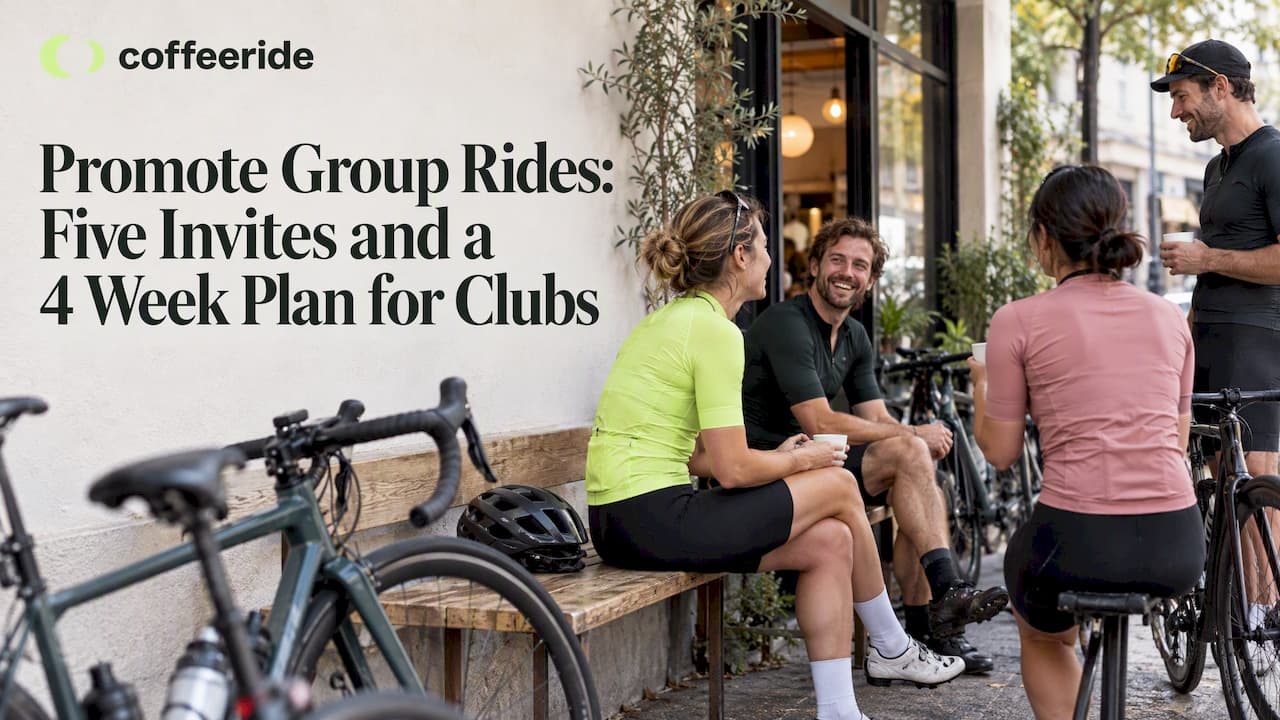
Three moves drive most of your turnout: personal invites, a clear event post built around the Five Essentials, and a social countdown in the final week. Start today: ask five regular riders to each invite one friend, publish an event listing with time, place, distance, pace, and no-drop status, then schedule a day-before reminder so nobody forgets.
TL;DR:
- Publish the event page three to four weeks ahead; use social posts for discovery, and group chats for RSVPs and weather or meeting changes.
- Each listing needs the exact start point, time, distance, pace, route hazards, and no drop status; RSVP forms should also collect emergency contacts.
- Beginner rides need roughly one leader per six riders, while advanced groups need one per eight; add a sweeper and split groups above 12 to 15.
- Personal invitations outperform passive sharing for turnout; ask volunteers to invite three to five people directly instead of asking them to share the event page.
Table of Contents
- Where to publish: event pages, social posts, and messaging that reach real riders
- Physical outreach and local credibility: posters, bike shops, and community noticeboards
- A copyable promotion timeline: 4 weeks to day-of actions
- A fill-in template: the Five Essentials plus RSVP fields that improve safety and turnout
- Practical pre-ride and on-ride steps that make newcomers stay
- Scaling attendance without spending money: volunteers, partners, and local press
- Applying the guide with Coffeeride: post templates, RSVP fields, clubs and filters
- Why rhythm beats production value
- Coffeeride Club: how to get started and why it helps your promotion workflow
- FAQ
- Sources
Where to publish: event pages, social posts, and messaging that reach real riders
Different channels do different jobs, and mixing them up is where most promotion plans lose steam. An event page (Facebook Event, Meetup, or a dedicated post on your club platform) is your logistics hub: the one place with the time, meeting spot, route link, and RSVP count. Social posts on Instagram or a story are for discovery: a hero photo of last week’s group at the coffee stop does more to pull in new riders than a paragraph of text ever will.

Every listing, regardless of platform, should include a strong image, a link to the route or a map file, and the Five Essentials (we cover each one in detail below). Closed channels like WhatsApp, Telegram, or your club’s group chat matter for a different reason: they’re where real RSVPs happen and where you reach people fast if the weather turns or the meeting point changes.
A posting cadence keeps the ride visible without becoming noise. Slovenia Tourism’s cycling promotion guidance recommends starting digital campaigns 3 to 4 weeks ahead, pairing Facebook groups for logistics with Instagram for visual engagement, and using countdown posts to build urgency as the date approaches.
- Announce the ride 3 to 4 weeks out on your main event page.
- Post a reminder with route highlights about 1 week before.
- Run a 3-day countdown post with a photo and the RSVP link.
- Send a short day-before message confirming time, weather plan, and meeting spot.
Pro Tip: Reuse the same hero photo style every week (same coffee stop, same group shot angle) so your rides become instantly recognizable in a crowded feed.
Physical outreach and local credibility: posters, bike shops, and community noticeboards
Not everyone scrolls cycling Facebook groups, and some of your best future regulars are the people who walk past a bike shop window or a library noticeboard. Physical promotion fills that gap and adds a layer of local credibility that a social post can’t replicate on its own.
Design a simple poster or flyer with the Five Essentials and a QR code linking straight to your event page, so someone can scan and RSVP on the spot. Print a small stack of spoke cards too: volunteers can hand these out on other club rides or group events, turning every outing into a recruitment opportunity for the next one.
- Place posters at bike shops, cafes, libraries, and community centers.
- Ask shop owners to pin the poster for at least two weeks before the ride.
- Offer a small post-ride coffee deal to participants who mention the poster.
- Hand out spoke cards at other rides, races, or local cycling meetups.
A shop that agrees to display your poster is also a shop that’s more likely to mention your ride to a customer buying their first commuter bike, which is exactly the kind of rider who benefits most from a welcoming group.
A copyable promotion timeline: 4 weeks to day-of actions
Promotion works best as a routine, not a scramble. Cycling UK’s event promotion checklist lays out a timeline that many community groups use, and it maps cleanly onto a volunteer-run club:
- 4 weeks out: Start word of mouth and reach out to partner shops or cafes.
- 3 weeks out: Get posters and flyers placed around town.
- 2 weeks out: Publish your first social announcement with the Five Essentials.
- 1 week out: Ask each volunteer to personally invite 3 to 5 people.
- 2 to 3 days out: Run a countdown post to build momentum.
- Day before: Send a final reminder covering weather, gear, and meeting logistics.
- Day of: Take photos with riders’ consent, sign people in, and post a thank-you with a link to the next ride.
Assign ownership early: one volunteer handles posters, another handles social posts, and the ride leader handles the day-before message. A script as simple as “Hey, a few of us are riding Saturday morning, easy pace, coffee after, want to come?” does more work than a generic share request.
A fill-in template: the Five Essentials plus RSVP fields that improve safety and turnout
Coverage of ride communication practices from Slovenia’s tourism press points to five pieces of information that belong in every group ride announcement, because leaving one out is the fastest way to get no-shows or mismatched riders.
- Time and place: the exact meeting point and start time, not just a neighborhood name.
- Distance: the total mileage or kilometers so riders can judge their fitness fit.
- Pace: described in plain terms riders can picture, like “social, conversational pace” or “steady rolling.”
- Route characteristics: hills, gravel sections, traffic, or anything that changes the ride’s difficulty.
- No-drop status: whether the group waits for everyone or splits by speed.
Pair the Five Essentials with a short RSVP form asking for name, contact info, bike type, whether they need a no-drop group, and an emergency contact. Our RSVP field guide covers which fields matter most for safety without asking for more than riders are comfortable sharing.
Pro Tip: Describe pace with both feel and numbers, like “social pace, about 12 to 14 mph,” so riders of different experience levels can self-select accurately.
Three quick templates to adapt:
- Beginner/social: “Easy 15-mile loop, no-drop, flat roads, coffee after. All paces welcome.”
- Training ride: “Steady 30-mile route with two climbs, drop ride for riders comfortable at 18+ mph.”
- Themed ride: “Sunset coffee ride, 10 miles, social pace, lights required after dark.”
Practical pre-ride and on-ride steps that make newcomers stay
Promotion gets people to show up once. What happens in the first ten minutes decides whether they come back. A short pre-ride briefing solves most of the anxiety a new rider feels standing at the edge of an unfamiliar group.
Cover introductions, a quick route summary, any known hazards, hand signals the group uses, whether photos will be taken (and an opt-out), and who to find if something goes wrong mid-ride. Our ride leader briefing scripts give you a 3 to 5 minute format that covers all of this without dragging out the start time.
Cycling UK’s ride leader standards handbook recommends a leader-to-participant ratio of roughly 1:6 for beginner rides and 1:8 for more advanced groups, with a dedicated backmarker or sweeper so nobody gets dropped without anyone noticing.
- Run a 2-minute name round so riders know who’s around them.
- Assign a buddy for anyone riding solo for the first time.
- Designate a sweeper to ride at the back of the group.
- End with coffee or a social stop so the ride doesn’t just end abruptly.
Groups larger than 12 to 15 riders benefit from splitting into two or adding an assistant leader, since a single leader managing a pack that size struggles to keep both the front and back of the group safe and included.
Scaling attendance without spending money: volunteers, partners, and local press
Slovenia Tourism’s research on community cycling events found that personal invitations from volunteers or regular riders outperform passive social sharing by a wide margin when it comes to actual turnout.
A script works better than a generic ask. Have volunteers say something like: “I’m leading a ride this Saturday, want to bring a friend?” rather than “Can you share our event page?” Asking someone to invite 3 to 5 people directly taps into a trust they already have, while a share just adds another post to a feed everyone scrolls past.
- Ask 5 regular riders to each personally invite 3 to 5 friends.
- Draft a 4 to 6 line press notice for local newspapers and community calendars.
- Propose a reciprocal share with cafes, bike shops, and local sport groups.
- Offer schools or youth groups a free beginner session to build goodwill.
If you work with local repair shops as promotion partners, it’s also worth pointing mechanics toward resources like CS Harness’s guide to cadence versus torque sensors, since shops that understand ebike diagnostics are often the ones most willing to support ebike-friendly group rides.
Pro Tip: A 4 to 6 line press notice sent two weeks ahead, followed by a one-line reminder a week later, is often enough to land a calendar listing without any paid promotion.
Applying the guide with Coffeeride: post templates, RSVP fields, clubs and filters
Every tactic above maps to a feature built for exactly that job. Post templates handle the Five Essentials, so you’re not retyping the same fields every week. RSVP fields capture contact info, bike type, and no-drop preference in one step, which helps leaders set ratios before the ride starts. Club pages can turn one-off rides into a recurring home base, and filters may help new members find a compatible crew.
- Set up a women-only ride with privacy-protected visibility.
- Post an ebike group ride in minutes using our ebike ride guide.
- Collect RSVPs for a no-drop MTB crew using our MTB group ride guide.
- Reuse your pre-ride checklist from our group ride etiquette guide every week.
Organizers running a recurring ride can set it once as a club event and let the filters do the matching work for every new member who joins afterward.
Why rhythm beats production value
A consistent weekly ride, same start, same time, builds loyalty faster than an occasional big production with a fancy poster and a one-off sponsor. Cycling Weekly’s reporting on community ride culture backs this up: over-structuring a social ride can actually shorten its lifespan, while a familiar rhythm keeps people coming back.
Try three small experiments this month: add one new RSVP field and see if it reduces no-shows, run a dedicated “bring-a-friend” week, and test a new poster spot you haven’t used before. Small, repeatable tweaks beat chasing a perfect single event.
— Coffeeride
Coffeeride Club: how to get started and why it helps your promotion workflow
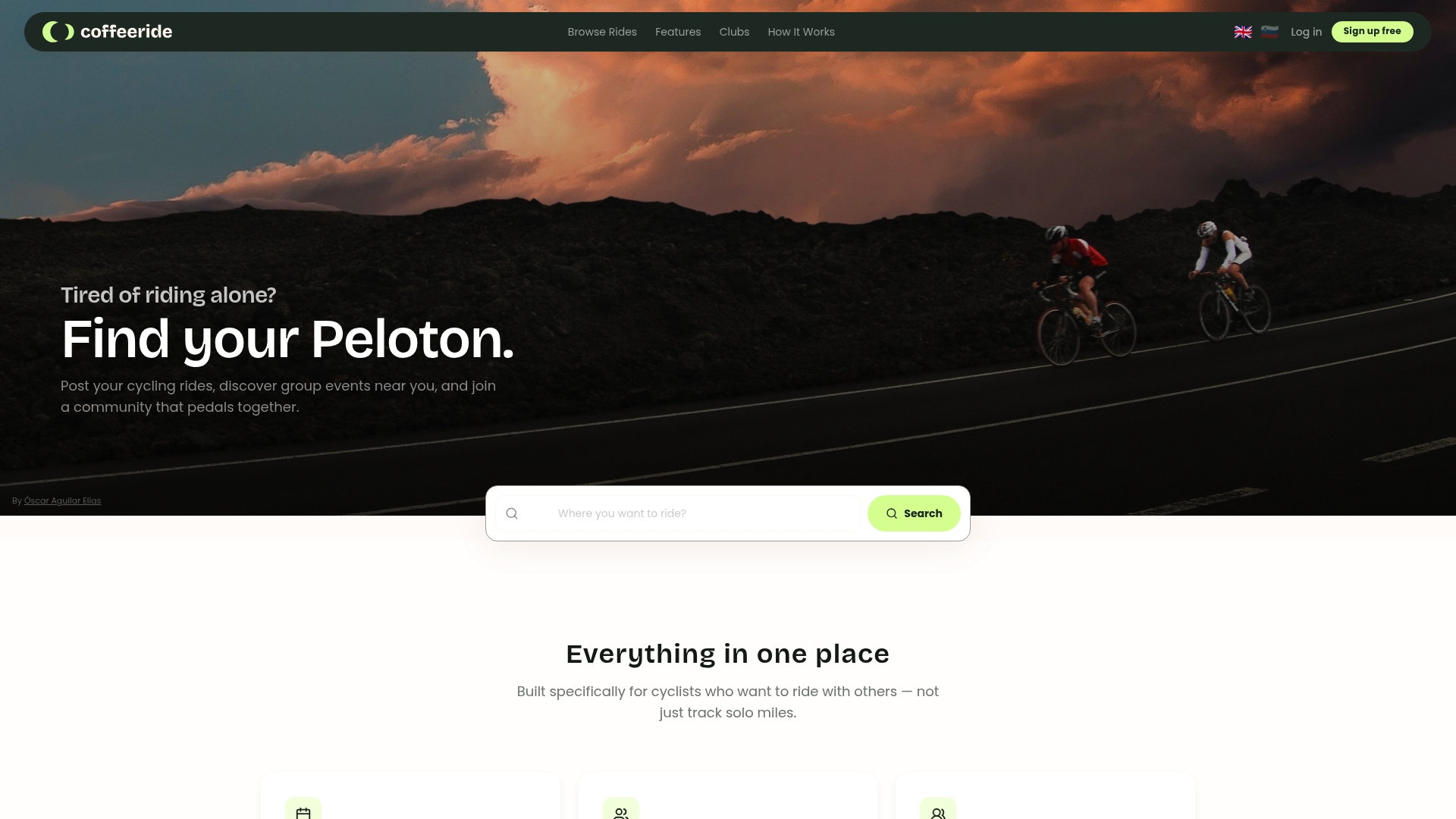
We built Coffeeride Club so posting a ride takes minutes, not an evening of formatting. Post your ride with the Five Essentials built in, use ready-made RSVP templates, run a club page for your regulars, and filter new joiners by pace and discipline so the right riders find you.
Getting started is simple: create your account, post your first ride, then invite your crew to join the club page. Head to Coffeeride Club and get your next ride in front of riders who are ready to show up.
FAQ
What is the 75% rule in cycling?
For group rides, it’s more useful to describe pace in plain language, like “social” or “steady rolling,” so riders of different fitness levels know what to expect.
What is the best app for group riders?
The best option depends on what you need: dedicated platforms for posting and joining group rides, like Coffeeride, focus on connecting riders by pace, discipline, and club rather than solo performance tracking. Look for one that lets you set RSVP fields, no-drop status, and recurring club events in one place.
What is rule 28 in cycling?
Rule 28 is part of the widely shared, informal “Velominati” rules of cycling culture, not an official governing body regulation, and it generally relates to etiquette around group riding behavior. Because it’s a community-created list rather than an official standard, definitions and numbering can vary depending on the source.
What is the 80/20 rule in biking?
For group ride organizers, the practical takeaway is to keep most social rides at an easy, welcoming pace rather than pushing intensity every week.
Sources
- Cycling UK — Event promotion: essentials checklist (2026)
- Slovenia Tourism — cycling tourism and digital marketing